
The Revenue Cost of Bad Roadmap Decisions
Saying yes to the wrong features fragments your sales motion and slows growth. Here's how to evaluate roadmap requests the right way.

Upward Growth provides health tech leaders with the playbooks and proof to transform complex markets into real growth. Each week, we deliver clear, practical strategies on positioning, messaging, and growth, so leaders can close enterprise deals and build repeatable momentum.
🤝 Work with Ryan on payor growth strategy: Contact me
🟦 Connect with the author, Ryan Peterson, on LinkedIn.
💡 Newsletter sponsorships are available: Learn More
Several CEOs have DM’d me recently, asking how to evaluate feature requests without fragmenting their growth motion, which prompted this article. Even if you think roadmap decisions are primarily a product concern, this article makes the case that they’re revenue decisions that affect your entire organization, including sales, customer success, operations, and how scalable your business becomes. Think of it as a guide to evaluating trade-offs through a growth lens, not just a product lens.
Roadmap decisions aren’t just product decisions. They’re growth decisions. And most health tech CEOs don’t fully realize it until they see the damage in their P&L.
It’s planning season. You’re finalizing next year’s roadmap while fielding requests from every direction. Sales wants features that will unlock deals stuck in pipeline. Customers are asking for customizations that would deepen relationships. Product teams are pitching capabilities that would differentiate in a crowded market.
Every request sounds rational. A feature that would help you win a national health plan deal seems like obvious ROI. A customization that protects your biggest Medicare Advantage customer feels like cheap insurance. A capability that would differentiate your Stars performance looks like smart positioning. But saying yes to the wrong features doesn’t just clutter your backlog. It often tanks your close rate, shrinks your deal size, extends your sales cycles, and fragments your expansion motion.
Often and understandably, health tech CEOs evaluate feature requests through a product lens. This article offers guidance on how to view it from a revenue lens, too. Here’s what you’ll learn: why feature requests feel impossible to refuse, what they actually cost you in revenue terms, how roadmap discipline drives growth, how to evaluate different types of requests, and how to build the organizational muscle to make these decisions consistently.
Why Saying Yes Feels Impossible to Refuse
The feature requests come with urgency attached. Sales tells you a prospect needs one capability to sign the deal, and it’s a deal you could really use. Your largest customer signals they’d expand into another line of business if you built a specific workflow. A competitor launches something new, and reps start hearing about it in demos. Your product team identifies a technical opportunity that would create real differentiation.
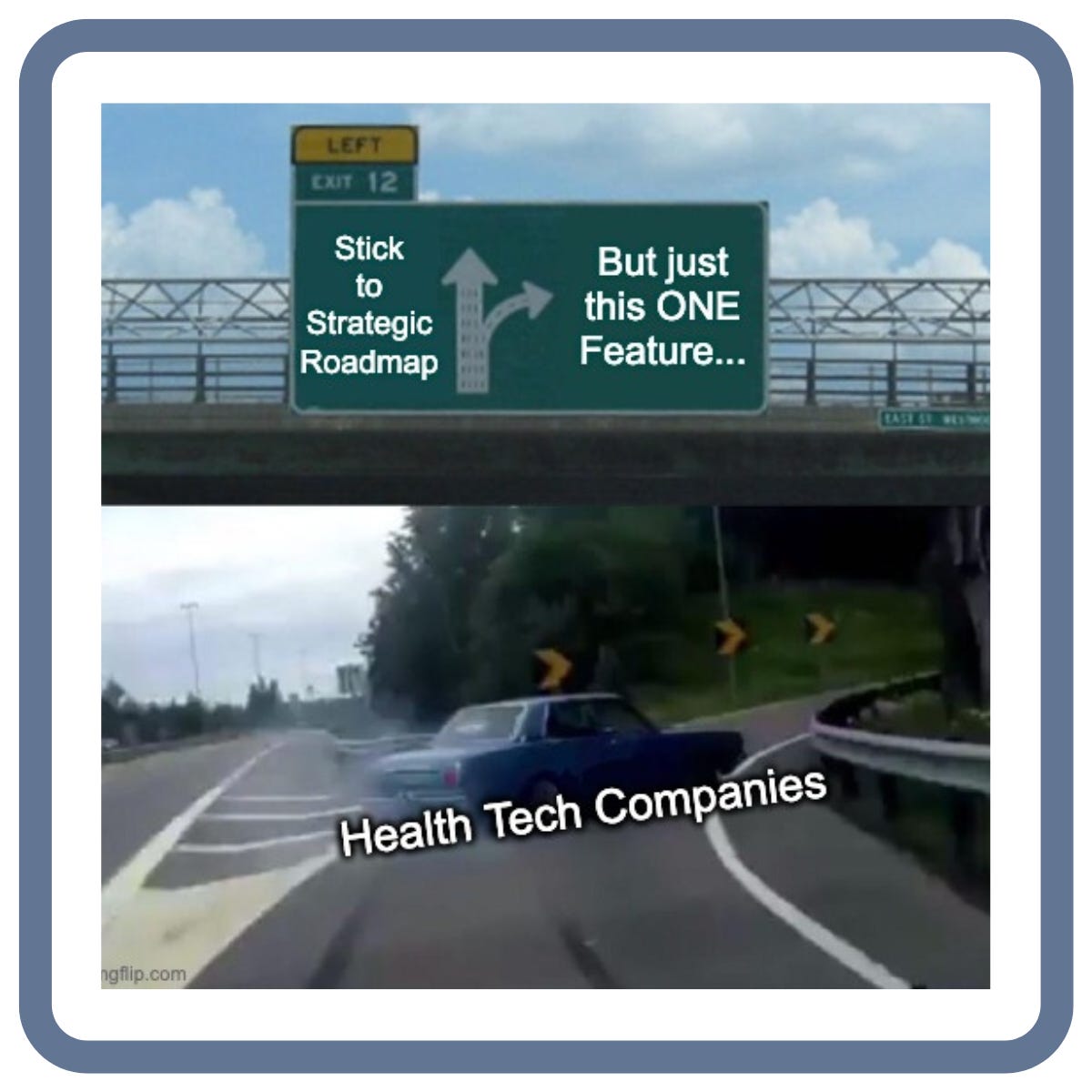
None of these is a bad reason to build something. The issue is that saying yes to all of them pulls you in directions that don’t compound. You end up selling to multiple Ideal Customer Profiles (ICPs) with different value propositions, and when prospects ask what makes you different, your reps can’t give a clean answer.
That’s what saying yes costs you. Not engineering time. Revenue.
The Revenue Cost of Saying Yes
Feature creep doesn’t appear as a line item on your P&L. Instead, it shows up as erosion across your entire sales motion: longer cycles, lower close rates, smaller deals, and (eventually) a sales team that can’t articulate what makes you different.
Here’s where saying yes actually costs you:
Your sales team stops running a consistent motion. Every new capability adds complexity to the pitch. New reps take longer to ramp because there’s more to learn and no clear hierarchy of what matters most. Experienced reps start freelancing the story, leading with different features depending on what they think will resonate. That variability kills repeatability. Close rates drop by 20 to 30 percent because half your pipeline is positioned around features that aren’t your differentiators. Deal sizes shrink by 25 to 40 percent because reps discount to close deals they can’t position cleanly. New rep ramp times double. The sales team blames market dynamics or competition. The real issue is that reps don’t have a sharp, consistent story anymore.
Your product becomes harder to adopt, which kills expansion velocity. More capabilities also mean longer onboarding, more training, and more configuration decisions. Time to first value stretches. Customers take longer to see wins, which also slows the expansion conversation. Net revenue retention declines because customers aren’t adopting fully enough to justify contract expansion. Your customer success team is firefighting adoption issues instead of driving growth.
Your growth motion becomes unpredictable and harder to scale. When you say yes reactively, every deal closes differently, every customer expansion path becomes unique, and your revenue forecasts become guesswork. You can’t hire to a repeatable playbook because what sold last quarter isn’t what’s selling this quarter. Investors or board members begin to focus on your growth model, and frankly, you struggle to articulate it clearly because there isn’t one (you’re just responding to whatever comes in).
The through-line is this: saying yes to feature requests feels responsive and customer-focused. What you’re actually doing is trading short-term opportunism for long-term revenue erosion. And the companies that recognize that early don’t just avoid the downside. They capture a significant upside.
The Revenue Upside of Saying No
Saying no to feature requests isn’t being conservative or rigid, but it IS about protecting and accelerating your growth motion. As I said at the beginning of the article, roadmap decisions aren’t product decisions. They’re growth decisions. That reframe changes how you evaluate every request that hits your desk. Vendors who maintain disciplined roadmaps grow faster and more predictably because their growth momentum compounds rather than fragments.
Here’s how discipline translates to revenue:
Sharp positioning drives higher win rates and deal sizes. When your reps can explain what you do and who you’re for in two sentences, prospects self-qualify faster and deals close at higher rates. When your positioning is muddied by features that serve different ICPs, prospects can’t figure out if you’re for them, and reps spend cycles convincing instead of closing. Vendors who stay focused on a specific segment close at rates around 35 percent, while those who chase adjacent markets average closer to 20 percent. And average deal sizes are higher than those of competitors who chase multiple segments.
Strategic features create buy-up motions and predictable expansion paths. When you’re reactive to build requests, every customer’s expansion path is different, making your expansion motion unpredictable. When you’re strategic about what you build, you create clear land-and-expand sequences that your customer success team can execute consistently. You design a staged expansion path (land with core functionality, expand to adjacent use cases, then buy up to premium capabilities) where each step is the natural next evolution, not a reactive response to a single customer’s request. That intentionality turns expansion from reactive to (more) predictable, which makes your growth model more efficient and your business more valuable.
Disciplined roadmaps make your sales organization easier to scale and more effective. When there’s a tight core offering and a clear story, hiring and ramping reps is faster and more predictable. New reps hit productivity twice as fast. Win rates hold steady as you scale the team because everyone’s running the same playbook. Your sales leader can forecast accurately because the motion is repeatable. When your product sprawls and your positioning is muddied, every new hire takes longer to ramp, performs more variably, and your forecast becomes useless.
Sales also needs a voice in roadmap prioritization. After all, they’re on the frontlines hearing what prospects ask for, what closes deals, and what causes friction. But that voice needs to come through a filter, not as veto power on every deal-specific request. The best roadmap processes give sales a structured way to advocate for features (through quarterly reviews where they can show patterns across multiple deals, not ad-hoc lobbying for one-off requests). That’s how you capture sales’ market insight without letting the loudest deal drive your roadmap.
The through-line is this. Roadmap discipline isn’t a constraint on growth; It’s a multiplier. When vendors stay focused, they win at higher rates, command bigger deal sizes, expand more predictably, and scale their sales orgs more efficiently.
Roadmap decisions aren’t product decisions.
They’re growth decisions.
That’s the upside of discipline. And capturing it requires a structured filter to evaluate which requests expand your growth motion and which fragment it. The paid section later in this article covers that filter (a five-question framework for roadmap decisions, how to decline requests without killing deals, and how to get sales and product aligned on trade-offs). But first, here’s how to think about the four types of requests you’ll encounter most often.
Four Requests You’ll Get (And How to Know Which Ones Are Traps)
Not every request deserves the same scrutiny. Some are genuinely strategic and will expand your growth motion. Others are expensive detours that fragment your focus. (Hint: Most fall somewhere in between.)
The skill is knowing which type you’re looking at before you commit resources. Here are the four types you’ll encounter most often and how each one affects your growth trajectory.
The Deal-Closer
Let’s say Sales brings you a solid deal, and the prospect is ready to move forward, but needs one capability you don’t have. The instinct is to say yes! That’s real revenue! The question that separates strategic investments from one-offs is whether this feature expands your TAM or serves a single buyer. If it’s for an adjacent buyer you’re not focused on, the contract value doesn’t matter. It’s still a distraction.
The Competitive Response
You start hearing buzz about a competitor's new capability in the market. Sales reps report that prospects are asking if you have the same thing. Your head of sales says you’re losing deals because you don’t have feature parity, so of course, this feels defensive and necessary to approve. However, the first question is whether you’re actually losing deals because of this feature, or whether it just feels like you should have it. If prospects are just asking about it without it being decisive, you’re building for perception, not reality.
The Customer Request
Your biggest customer says they’d expand their contract if you built something specific for them. This feels low-risk because after all, you’re building for someone who already trusts you. The real question, though, is whether this unlocks expansion across your customer base or serves one account. If it benefits your broader base, build it. If it’s one account’s unique need, you’re building something that won’t drive growth across your customer base.
The Innovation Bet
Your product team is excited about something technically interesting and differentiated. They say it’s where the market is going. (These are often hard to evaluate because they’re forward-looking.) The question is whether this makes your solutions easier to buy or simply more interesting to talk about. If it makes you meaningfully better at something your ICP actually cares about, it’s strategic. If it’s innovation for innovation’s sake, it’s a project that will consume resources without moving revenue.
These four types cover most roadmap requests. Recognizing which type you’re looking at is the first step. Actually making the call (when sales is lobbying for a deal-closer, your biggest customer is threatening to churn, or product is pushing an innovation bet) requires a framework. The paid section covers the five-question filter that separates strategic investments from expensive detours, three ways to decline requests without killing deals, and how to align sales and product on what gets built.
