
Why "AI-Powered" Is Costing You Health Plan Deals (And What to Say Instead)
AI messaging now triggers skepticism, not interest. The vendors still winning changed what they lead with.

Upward Growth provides health tech leaders with the playbooks and proof to transform complex markets into real growth. Each week, we deliver clear, practical strategies on positioning, messaging, and growth, so leaders can close enterprise deals and build repeatable momentum.
🤝 Work with Ryan on payor growth strategy: Contact me
🟦 Connect with the author, Ryan Peterson, on LinkedIn.
💡 Newsletter sponsorships are available: Learn More

Every vendor deck now says “AI-powered.” The term has been diluted to the point where it signals nothing.
I’ve written before about this problem: if a competitor achieved identical outcomes using a completely different approach, would your buyer care how you built it? Almost always, the answer is no. They’d buy whoever gets them the result. Saying “we use AI” is like a health plan saying “we use claims data.” Of course you do. The question is what you accomplish with it.
But here’s what most vendors haven’t fully internalized: health plan buyers aren’t just tuning out AI messaging. They’re actively skeptical. “AI-powered” now triggers a specific set of concerns that didn’t exist two years ago.
The turning point was 2024. Between spring and fall, every booth at every conference slapped “Now with AI” on its signage like a cereal box advertising a new flavor. Vendors who already sounded similar became indistinguishable. By the time 2025 hit, those words had lost all meaning. Buyers stopped hearing “innovative” and started hearing “same as everyone else.”
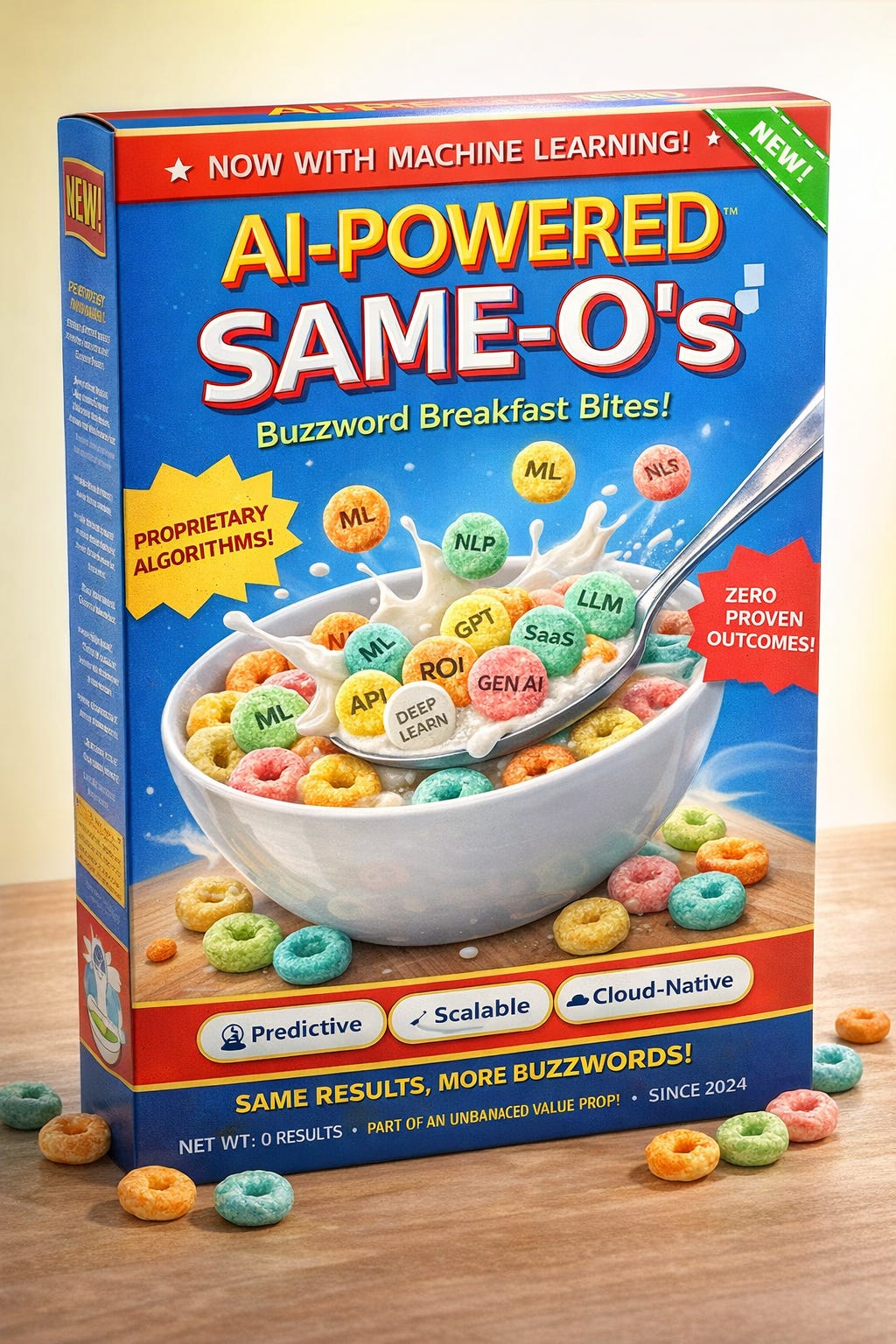
What used to be an asset is now a trust tax. You have to prove AI isn’t a liability before you can position it as a strength. The vendors who’ve figured this out are positioning completely differently, and they’re winning deals while their competitors wonder why “AI-powered” stopped working. This article breaks down that shift: what buyers actually hear when you lead with AI, the reframing that changes the conversation, and how to make AI a credible part of your value story rather than the thing that triggers skepticism.
McKinsey's Q4 2024 survey of 150 healthcare leaders found that 85% were exploring or had already adopted gen AI capabilities. That's not innovation. That's saturation.

Four Things Running Through Your Buyer’s Mind When You Lead with AI
When you lead with AI, here’s what runs through a health plan buyer’s mind. They won’t say them out loud, but these thoughts are shaping every question they ask and every objection they raise.
1. “What happens to our patient data?”
Where does the data go? Who has access? Is our data used to train your models? What happens in a breach? PHI plus AI equals a compliance conversation they don’t want to have with their legal team. Health plans have spent years tightening data governance, and every new vendor relationship gets scrutinized. AI feels like a step backward, not forward, because it introduces variables they don’t fully understand and can’t fully control.
2. “Has this actually worked at scale?”
Health plans don’t want to be guinea pigs for technology that sounds impressive but hasn’t been validated in real-world conditions. “AI-powered” often translates in the buyer’s mind to “we built something cool, and now we’re looking for someone to test it.” Is this proven with a population like ours, or are we the pilot?
3. “How much lift does this require from us?”
Implementation complexity is already a concern with any new vendor, and AI makes it worse. Buyers assume AI means IT resources, integration headaches, workflow changes, and a long runway before they see value. The last thing an already-stretched operations team wants is a vendor promising transformation that requires six months (or more) of internal work before anyone sees results.
4. “Is this a real company or a feature wrapped in a funding pitch?”
Vendor stability concerns are heightened with AI companies. Buyers have watched enough startups pivot, get acquired, or run out of runway. When your pitch leads with AI, some part of the buyer’s brain is calculating how long you’ll be around and whether betting on you is worth the switching cost later.
The irony is that AI might actually reduce their risk, improve accuracy, and simplify operations. But leading with “AI” triggers the opposite assumption. Health plans have been burned by tech promises before (not just AI, but any “revolutionary” tool), and the credibility bar for AI is now higher than for any other capability you’ll pitch.
There’s another layer to this that most vendors miss: many health plans have internal data science teams running their own predictive models. Some have been experimenting with AI for years. When you lead with AI, you’re often talking to someone who’s already tried something similar, or who’s evaluating three other vendors making the same pitch. You’re not impressing them, you’re inviting comparison. The better move is to lead with the specific outcomes you’ve delivered, then let them ask how you got there. If they’ve tried and failed to move that metric internally, now you have their attention for a different reason: you solved something they couldn’t.
This is the trust tax I mentioned. Before you can talk about what AI does for them, you have to overcome the assumption that it’s a risk. That’s why leading with AI backfires. You’re triggering concerns before you’ve built any credibility to address them. The fix isn’t to hide that you use AI. It’s to change what you lead with.
Lead with Results, Not the Technology That Gets You There
If leading with AI triggers skepticism, what do you lead with instead? The answer is almost embarrassingly simple: lead with results.
Run this test on your own positioning. If a competitor got the same outcome using a completely different technical approach, would the buyer care how you built it? Would they pay more for the AI version? Almost always, the answer is no. They’d buy whoever gets them the result. That means your positioning needs to lead with the result, not the technology. AI becomes something you mention when the buyer asks, “How do you do that?”, not the headline of your pitch.
Here’s what that shift looks like in practice:
Technology-first: “Our AI-powered platform uses machine learning to analyze member data and predict risk.”
Outcome-first: “We reduce avoidable ED visits by 18% in high-risk populations. Here’s the data from three regional plans.”
Technology-first: “Our natural language processing (NLP) engine automates prior authorization decisions.”
Outcome-first: “We cut prior auth turnaround from 5 days to 4 hours while maintaining 99% accuracy. That’s 340 hours of staff time back per month for a plan your size.”
Technology-first: “Our AI identifies gaps in care through predictive analytics.” Outcome-first: “We catch 31% more gaps in care than manual chart review, and we do it in hours instead of days.”
The difference isn’t subtle. One version asks the buyer to be impressed by technology. The other gives them a number they can take to their CFO.
Three questions to pressure-test your positioning:
What specific metric does this improve for the health plan? If you can’t name the metric, you’re not ready.
Can we prove it with the data they already track? If they have to build new reporting to see your impact, adoption will stall before it starts.
Would this message be credible if we never mentioned AI? If the answer is no, you’re leaning on the technology as a crutch rather than letting the results speak for themselves.
The vendors winning health plan deals aren’t hiding that they use AI; they’re just not leading with it. They’ve realized that outcomes build the credibility that makes AI messaging land. Get the sequence backwards, and you’re fighting the trust tax.
There’s also a revenue dimension to this that most vendors miss. When AI was novel, you could charge a premium for it. Now that everyone says it, leading with AI compresses your pricing power. You’re inviting a technology comparison, which becomes a feature checklist, which becomes procurement leverage to drive your price down. The vendors maintaining premium pricing have shifted the conversation to outcomes that are hard to replicate. When the buyer is evaluating you on results rather than capabilities, the question stops being “why should we pay more for your AI?” and becomes “what’s it worth to us to get these results?” That’s a different negotiation entirely.
That raises an obvious question: if you’re not leading with AI, when do you bring it up at all?
When to Mention AI (And When to Let Outcomes Lead)
The goal isn’t to hide AI. It’s to introduce it at the right moment, in the right way, so it reinforces your credibility instead of undermining it.
Bring up AI when the buyer asks directly (they will eventually), when AI explains why your results are better, faster, or more accurate than alternatives, when it addresses a specific concern they’ve raised about accuracy or speed or scale, or when you’re in late-stage procurement and they need technical specifics for their evaluation. In these moments, AI becomes a proof point rather than a pitch. “The reason we can identify risk across your entire population, not just a sample, is because our models run continuously rather than relying on quarterly manual review.” That’s AI as an answer, not AI as a buzzword.
Let outcomes lead when you’re in early conversations focused on problem and fit, when the buyer is already skeptical of vendor hype (read the room), or when your outcome story is strong enough to stand alone. If you can say “we reduce readmissions by 14%” and back it up, you don’t need AI to carry the pitch. Your goal in early conversations is to establish whether there’s a match, not to explain your tech stack.
The exception: When a buyer is explicitly seeking AI capabilities (whether through an RFP that scores for it or because they’re a tech-forward plan looking to innovate), lean into the technology. But recognize that this buyer is prepared to take risks and ride the edge. Frankly, that’s not your typical risk-averse health plan buyer. For most conversations, the guidance above applies.
Language shifts that reduce skepticism. Instead of “AI-powered,” try “automated,” “predictive,” “real-time,” or “continuous.” These words describe what the technology does without triggering the baggage that “AI” now carries. You’re not hiding anything. You’re describing capabilities in terms that matter to the buyer.
The “proof sandwich” structure. When you do talk about AI, sandwich it between outcomes. Outcome, then how AI enables it, then outcome again. Example: “Four health plans we support have each seen a 19% reduction in medication adherence gaps within six months. Our models flag members likely to miss a fill before it happens, so care managers can intervene proactively. ” The AI is in there. But it’s surrounded by results, which is what the buyer actually cares about.
Here’s the counterintuitive part: the more boring your AI explanation, the more credible it sounds. Vendors who try to impress buyers with technical sophistication often trigger more skepticism, not less. When you explain AI in plain, almost mundane terms (“we use pattern recognition on claims and pharmacy data to flag high-risk members”), it sounds like something that actually works. When you use phrases like “cutting-edge machine learning” or “proprietary algorithms,” it sounds like marketing. In most situations, boring actually wins.
The mistake smart vendors make. The sophisticated version of this problem is the vendor who moves AI from slide 1 to slide 3, but still structures the entire conversation around the technology. They’ve heard “lead with outcomes,” but they’re executing it as “mention outcomes briefly, then spend 20 minutes on a technical deep-dive nobody asked for.” The sequencing changed, but the message didn’t. If you find yourself spending more time explaining how your AI works than discussing the buyer’s problem and your results, you’ve fallen into this trap.
There’s one conversation, though, where you can’t be boring or vague: data security. How you handle that conversation often determines whether the deal moves forward or stalls indefinitely.
The Security Conversation Is an Opportunity, Not an Obstacle
Most vendors treat security questions as an obstacle to overcome. That’s a mistake. This conversation is actually your best opportunity to build credibility, and mishandling it can kill deals even when everything else is going well.
Buyers will ask (or worry silently) about where the data lives, who has access, whether their data is used to train your models, and what happens in a breach. The training question is a big one. Many plans assume the answer is yes, and they’re not comfortable with it.
Don’t wait for them to ask. Raise it yourself in mid-funnel conversations: “I know data security is a priority for your team, so let me address that directly. Your data stays in a dedicated environment. We don’t train on customer data. We’re SOC 2 Type II and HITRUST certified. Happy to walk through our compliance documentation or connect you with our security team.” Being proactive signals that you understand their concerns and have nothing to hide. Waiting for them to ask puts you on defense.
Here’s why this conversation is actually an opportunity: being upfront about limitations and safeguards makes everything else you say about AI more credible. When you say “we don’t train our models on customer data” or “our models work well for populations over 10,000 members, but below that threshold we’d recommend a different approach,” you’re demonstrating that you understand the risks and have thought through the edge cases. Buyers trust vendors who acknowledge complexity. Vendors who brush past security questions or give vague assurances (”we take security very seriously”) lose credibility fast.
What to have ready before you need it: clear, plain-language answers on data handling (not just legal boilerplate your buyer can’t parse), compliance documentation (SOC 2, HITRUST, BAA templates), and a technical contact who can go deeper with their security team if needed.
The vendors winning AI deals have stopped treating security as a checkbox and started treating it as a differentiator. When your competitors fumble this conversation, you have an opening.
How AI Fits in Early, Mid, and Late-Stage Conversations
Where AI fits in your pitch depends entirely on where the buyer is in their process. Get this wrong, and you’re either burying something they need to hear or leading with something that triggers skepticism. Here’s how to calibrate.
For early-stage conversations (discovery, qualification), lead with problem and outcome. Mention AI only if asked. Your goal is to establish fit, not explain your tech stack. If they ask how you do it, give a brief answer and pivot back to results: “We use predictive models to identify high-risk members before they become high-cost. The bigger question is whether reducing avoidable admissions is a priority for you this year.”
For mid-funnel (evaluation, building the business case), use AI as a “how we’re different” proof point, not a headline. This is where you explain why your approach produces better results than alternatives. Frame AI as the reason your outcomes are better, faster, or more scalable: “The reason we can do this across your entire population rather than a sample is because our models run continuously rather than relying on quarterly manual review.” At this stage, the buyer has already decided the problem is worth solving. Now they’re evaluating whether you can solve it better than alternatives.
For late-stage (procurement, contracting), be specific and technical. Avoid marketing language entirely. Their procurement and IT teams will ask detailed questions. Have answers ready. This is where you bring in technical resources who can speak credibly to how the technology works without overselling it.
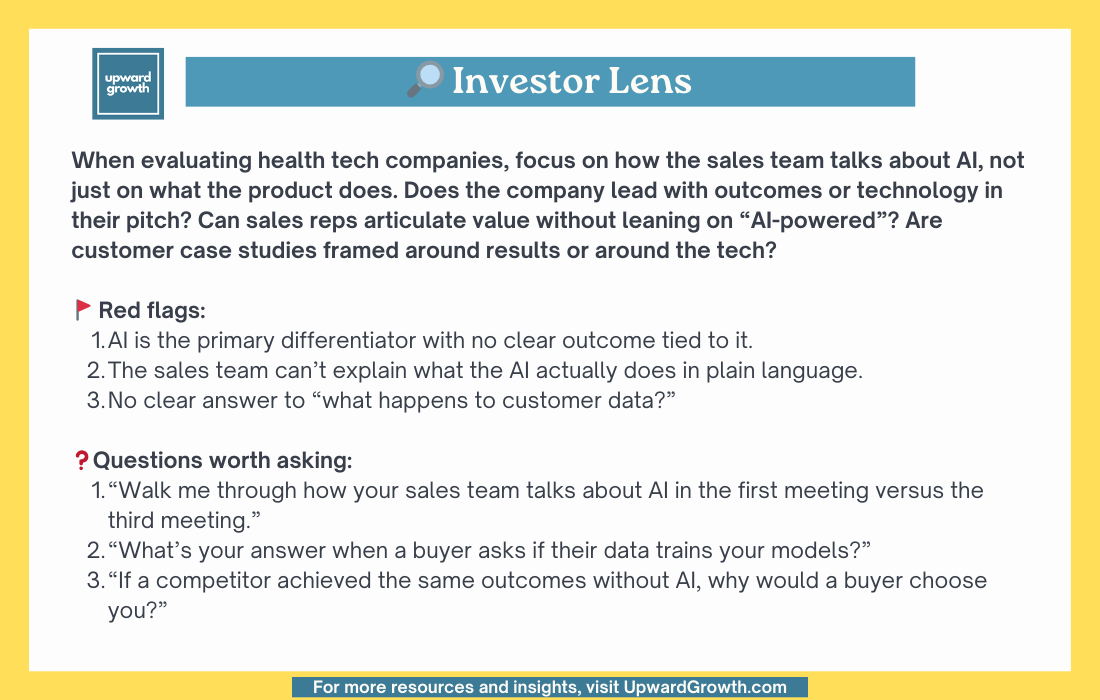
Red flags that you’re over-relying on AI positioning: Your first slide mentions AI before it mentions outcomes. You can’t articulate your value proposition without referencing the technology. Buyers keep asking, “But what does it actually do?” after you’ve explained it. Your differentiation disappears if competitors use the same technical approach.
AI’s Real Win Is Disappearing from Your Pitch Entirely
Here’s the thing about AI in health tech sales: The technology that actually transforms an industry eventually becomes invisible. Nobody pitches “cloud-based” anymore. Nobody explains how the internet works. AI is heading in the same direction. The vendors still leading with it are advertising that they haven’t figured this out yet.
“The technology that actually transforms an industry eventually becomes invisible.”
That’s not a prediction about some distant future. It’s already happening. The vendors closing deals today aren’t the ones with the most impressive AI. They’re the ones who’ve made AI a background capability, something that powers their outcomes rather than something they need to explain and defend.
The transition from “look at our AI” to “look at our results (powered by AI)” isn’t just a messaging shift. It’s a maturity signal. Buyers can tell the difference between a company that’s still excited about their technology and a company that’s focused on solving problems. One sounds like a startup. The other sounds like a partner.
You’ve reached the end of the free article.
What’s below is the part I actually use with clients: the specific language for when buyers push back on AI, a security conversation script you can run in your next meeting, and a structure for talking about AI that makes it disappear into the background where it belongs.
A paid subscription unlocks this section, plus the full archive of paid subscriber deep-dives, positioning frameworks, and scripts.