
Blues Plans Are Consolidating From Within. Your Pipeline May Not Reflect It Yet.
What's driving the wave of Blues affiliations, what the CMS data actually shows, and what changes about how you sell to a Blue that's now part of something bigger.

Upward Growth provides health tech leaders with the playbooks and proof to transform complex markets into real growth. Each week, we deliver clear, practical strategies on positioning, messaging, and growth, so leaders can close enterprise deals and build repeatable momentum.
🤝 Work with Ryan on payor growth strategy: Contact me
🟦 Connect with the author, Ryan Peterson, on LinkedIn.
📰 Newsletter sponsorships are available: Learn More
This Upward Growth newsletter is sponsored by Charm Economics

Charm Economics is a boutique healthcare analytics and economic research firm specializing in advanced health economics modeling to evaluate the financial and societal impact of proposed policy changes. Our team includes Harvard-trained health economists with experience navigating Capitol Hill and CMS regulatory processes.
We produce rigorous budget impact analyses and policy scores that help healthcare organizations, industry leaders, and policymakers understand the fiscal implications of new technologies, treatments, and regulatory reforms. By translating complex economic analysis into clear, evidence-based insights, Charm supports informed legislative decision-making.
Contact us to get an initial scoring consultation.
Interested in sponsoring Upward Growth? Learn more

🎁 Unlocked: This post includes the full deep dive
Most Tuesday articles start with a free section and then continue behind the paywall. Today’s post is left completely open so you can read the entire edition.
Paid subscribers get the full deep dive every week, plus playbooks, case breakdowns, and the ability to reply with their own questions.
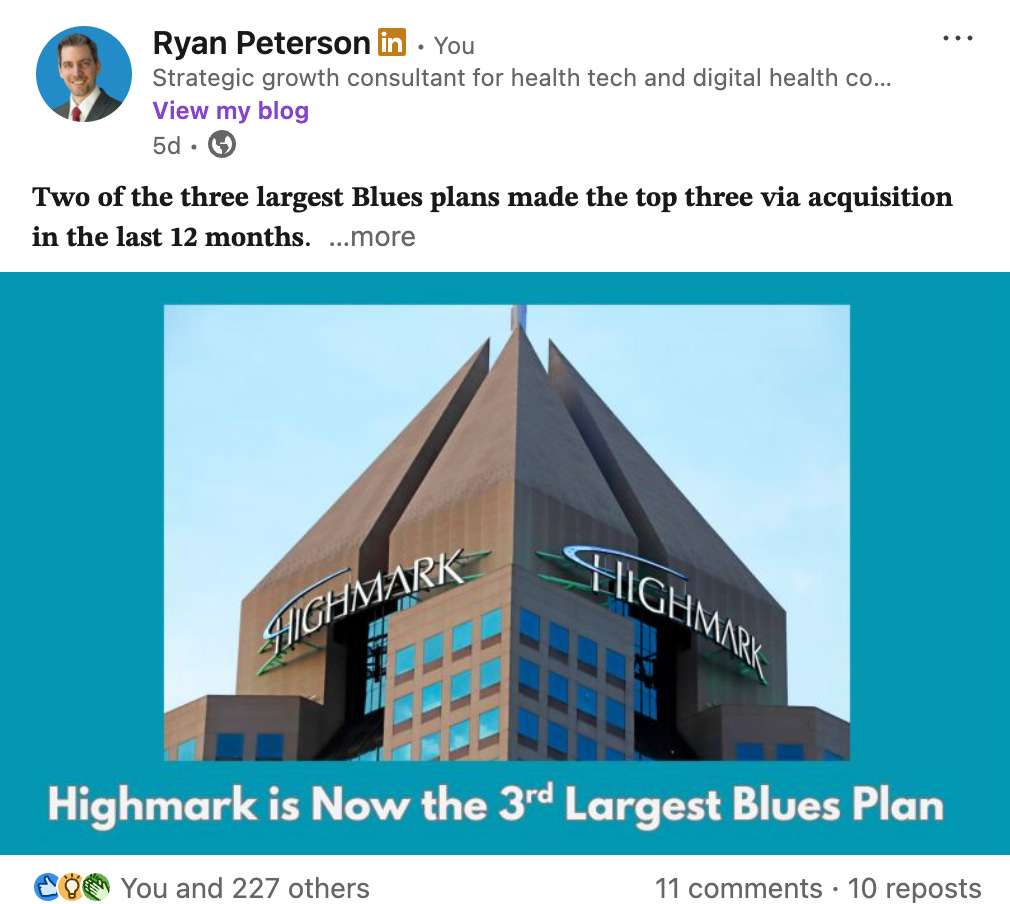
The Blue Cross Blue Shield system is consolidating from within, and the pace over the last 12 months has been striking. HCSC spent $3.3 billion to absorb Cigna’s entire Medicare business. Highmark is closing its affiliation with Blue KC on March 31. Cambia has pulled in both BCBS North Dakota and Arkansas BCBS within the same year. Multiple other Blues have restructured their corporate entities, suggesting more deals are coming.
If you sell to Blues plans, this is reshaping the organizations you’re selling into in real time. Parent organizations are forming where independent plans used to be, vendor decisions that were made locally are starting to migrate upward, and pipeline opportunities you thought were separate deals may roll up to the same buyer. And even if your company focuses on Medicare Advantage or Medicaid, the forces driving this consolidation are hitting Blues plans across every line of business. Financial losses on commercial books, a new competitive threat in the employer market, and infrastructure costs that small plans can’t shoulder alone are pulling leadership attention, draining reserves, and changing how these organizations think about their future.
After I posted a Blues consolidation leaderboard on LinkedIn last week (200+ likes and a pile of DM convos later), I fell into a bit of a Blues rabbit hole. I started pulling CMS March 2026 enrollment data and mapping every Blues MA contract to its parent organization and state. What came back was a picture of a system that’s further along in consolidation than most people in health tech realize, driven by forces that show no sign of easing.
This article covers what’s driving the consolidation and why it won’t slow down, maps the largest Blues organizations by MA lives, unpacks CMS data findings that tell a different story than the headline numbers, and walks through what changes about how you sell to a Blue that’s now part of something bigger. I also built a full parent-organization enrollment map breaking out MA lives vs. total lives by parent and state. More on how to access that below.
What’s Happening to the Blues and Why It’s Accelerating
Three forces are hitting the Blues system at the same time, and each one compounds the others.
1. Blues plans are losing money at a scale that threatens their ability to operate independently. At least seven Blues reported financial losses in 2024. BCBS Michigan lost $1.03 billion on $40.6 billion in revenue and has now posted five consecutive years of underwriting losses. BCBS Massachusetts posted its largest operating loss in history at $400 million in 2024, then followed it with another $380 million operating loss in 2025. Rhode Island lost $115 million after a 20% increase in healthcare costs. Arkansas was hemorrhaging over $100 million before it signed its affiliation agreement with Cambia.
BCBS Vermont’s reserves dropped from $133 million to $58 million in four years. Their credit rating was downgraded twice in a matter of months, from “good” to “marginal.” They pay out $35 million a week in claims. When your reserves cover six weeks of claims, well…things are not good.
The drivers are consistent everywhere: medical cost inflation outpacing premium growth, pharmacy costs surging (GLP-1 drugs alone now represent 20% of BCBS Massachusetts’ total pharmacy spend), and utilization rates that haven’t come back down since the post-COVID surge. A 45-million-member organization like Elevance can absorb a bad year, but a single-state Blue with a few hundred thousand members and shrinking reserves cannot. The affiliation deals get the headlines, but frankly, it’s the financial losses that left these plans with no choice that are worth understanding.
2. A landmark antitrust settlement is creating competition inside the Blues family for the first time. A $2.67 billion settlement resolved allegations that Blues plans conspired to divide markets and avoid competing with each other. Among several changes, the settlement introduced the “second blue bid,” a provision that allows large, geographically dispersed, self-funded national employers to solicit bids from any Blues plan in the country, not just the one licensed in their geography.
Even if your organization focuses on Medicare Advantage or Medicaid, the second blue bid matters to you. When a smaller Blue loses a major self-funded employer account to Elevance or HCSC, that revenue loss hits the plan’s overall financial position. It weakens the reserves that support every line of business. It reduces the operating scale that funds technology investments, compliance infrastructure, and the people who run Medicare and Medicaid programs. Health plans don’t have separate balance sheets for each line of business.
The first results of the second blue bid are already in. Elevance bid on 11 national accounts in other Blues' territories in 2025 and won 9 of them. For smaller Blues that depend on a handful of large employer accounts for a significant share of their commercial revenue, that kind of competitive pressure from within the Blues family is new. It didn't exist 18 months ago, and it gives financially stressed plans one more reason to look for a partner with the scale and infrastructure to compete.
3. The technology and infrastructure gap is widening faster than small Blues can close it. A single-state Blue can’t build the claims platform, analytics infrastructure, or regulatory compliance systems that CMS requirements now demand. When BCBS North Dakota’s CEO said affiliating with Cambia allows them to “leap ahead in the capabilities we can bring” to their members, he was describing a gap that cost-cutting alone cannot close.
The affiliations get the headlines, but the financial losses that left these plans no choice are the part worth understanding.
These forces feed each other. Financial losses erode the reserves needed to invest in technology. The second blue bid means a smaller Blue can now lose its biggest commercial accounts to a larger Blue with better infrastructure and deeper pockets. For the plans caught in that cycle, affiliation is how they attempt to break out of it. And the financial scrutiny reshaping how plans evaluate every dollar of vendor spend is the same scrutiny these plans are applying to their own operating model.
The Blues Leaderboard Looks Different Than It Did Two Years Ago
The leaderboard shows what those forces have already produced. Ranked here by total membership, the top five Blues organizations look different from what they did two years ago. But the story underneath them matters just as much, because it shows how many plans beyond the largest are actively moving toward affiliation or restructuring to make it possible.
1️⃣ Elevance (Anthem): ~45M members across 14 BCBS states. Elevance has always operated more like a national carrier than a federation of local plans. They tried to acquire BCBS Louisiana in 2024 and got blocked after policyholder and regulatory pushback. But the second blue bid changes their competitive posture entirely. They can now compete directly for national accounts in other Blues’ territories, and their first-year record (9 wins out of 11 bids) speaks for itself.
2️⃣ HCSC: ~26.5M members. HCSC closed its $3.3B acquisition of Cigna's Medicare business in March 2025 adding 3.6 million Medicare members. They now operate Blues plans in IL, TX, OK, NM, and MT, plus Medicare plans across 30 states under the HealthSpring brand. The CMS data reveals how much this acquisition reshaped the organization: 71% of HCSC’s MA enrollment is in HealthSpring, not in its legacy Blues plans. HealthSpring operates through its own subsidiary entities (HealthSpring Life and Health Insurance Company, HealthSpring of Florida, and others), has its own Government Markets leadership, provider networks, and payer IDs and provider portal. How much of that operational separation persists over time is an open question, but right now, the HealthSpring side and the legacy Blues side are distinct operations. If your relationship is with the Blues side, you’re connected to less than a third of their MA book.
3️⃣ Highmark: ~8M members. Affiliates in PA, DE, WV, and NY, with the Blue KC affiliation closing March 31, 2026, moving them from #4 to #3. Highmark has been the most methodical acquirer in the Blues system, building shared services and technology infrastructure across affiliates while preserving local governance. Integration tends to move slowly under this model, but the direction toward shared infrastructure and, eventually, a shared vendor strategy is consistent.
4️⃣ Florida Blue / Blue Shield of California: ~6M members each. Two large single-state plans that haven’t affiliated yet. Blue Shield of California reorganized its corporate structure to create flexibility for future deals. Florida Blue operates under GuideWell, whose MA book is split 53% Florida Blue and 47% Triple-S Advantage in Puerto Rico. That split matters if you sell to Florida Blue and your results are Florida-only, because the parent organization’s MA portfolio looks very different from what you’re seeing in one state.
5️⃣ BCBS of Michigan: ~5M members. Michigan is #5 in total members, but #3 in MA lives, so their Medicare Advantage business is a much larger share of their organization than the overall membership number suggests. Their parent group includes Wellmark (IA/SD), NextBlue (ND), WyoBlue (WY), and the BCBS Vermont affiliation. Five states under one parent, and growing.
The pattern underneath the top five is where this story gets harder to dismiss. The smaller Blues affiliations of the past two years share a common thread. Arkansas BCBS reported losses exceeding $100 million in 2024, and reporting on the affiliation with Cambia cited “rising financial challenges” as the driving context. Vermont’s affiliation with Michigan followed the collapse of reserves and two credit rating downgrades. North Dakota’s affiliation with Cambia was framed around technology capabilities that the plan couldn’t build on its own. Each situation is specific, but the underlying math is the same: the cost of staying independent exceeded what the plan could sustain.
Cambia has now pulled in BCBS North Dakota (effective February 2026) and Arkansas BCBS (expected to close later this year), bringing its total to six affiliated Blues plans across the Pacific Northwest, Mountain West, Great Plains, and the South. Horizon BCBS New Jersey and Blue Cross of Idaho have both restructured their corporate entities in ways that appear designed to enable future affiliations.
The plans that haven’t affiliated yet are watching the ones that did and doing their own math. What the CMS data adds to that picture is a view of how these organizations are actually structured today, which is where the headline membership numbers start to break down.
What the CMS Data Reveals That the Leaderboard Doesn’t
The leaderboard shows size. The CMS enrollment data shows structure, and structure is what determines who you’re actually selling to and how decisions get made inside these organizations.
When I mapped every Blues MA contract to its parent organization, a few things stood out that the headline membership numbers obscure.
The total lives ranking and the MA lives ranking are different lists. Highmark is #3 in total members but #4 in MA. BCBS Michigan is #5 in total members but #3 in MA. If you sell Medicare Advantage solutions, the ranking you’re using to prioritize your Blues pipeline may not be the right one.
HCSC’s Medicare Advantage business is 71% HealthSpring. I covered the org structure in the leaderboard section, but the enrollment split is worth sitting with. The legacy Blues MA plans in Illinois, Texas, Oklahoma, New Mexico, and Montana make up less than a third of HCSC’s total MA enrollment. As HCSC integrates the HealthSpring acquisition over the coming years, vendor decisions that are currently made separately on each side will presumably start to converge. If you sell MA solutions to HCSC and have relationships only on one side of that organization, now is the time to understand the other side before integration decisions are made without your input.
Elevance’s Florida MA presence runs through Freedom Health, Optimum, Simply Healthcare, and HealthSun. If you’re prospecting Elevance in Florida and searching for “Anthem” in your research, you won’t find the plan entities where MA members are actually enrolled or where local vendor and provider decisions get made. The parent-level branding and the operating-level reality are different names, different entities, and in some cases, different procurement paths.
GuideWell’s MA book is split 53% Florida Blue and 47% Triple-S Advantage in Puerto Rico. If you sell to Florida Blue and your pitch is built entirely on Florida market data, you’re telling a story about roughly half of the parent organization’s MA portfolio. When the parent starts thinking about vendor strategy across its full footprint (and the consolidation trend suggests that’s a matter of when, not if), a Florida-only value proposition leaves a gap.
Access the Blues Parent-Organization Enrollment Map
I pulled the CMS enrollment data and mapped every Blues MA contract to its parent organization and state, breaking out MA lives and total lives across the system. Click here to request access and I’ll send it to you. If you find it useful, share it with your team or forward this article to a colleague.
What Actually Changes When You Sell to a Blue That’s Affiliated
If you sell to a Blue that’s recently affiliated or is positioning to, there are a few questions worth adding to your discovery:
How are vendor and technology decisions being made now compared to a year ago?
Is there an enterprise vendor strategy forming at the parent level that we should be aware of?
We’re live at [affiliated plan]. Would sharing those results be valuable context for your evaluation?
That last question matters the most if you already have an installed base at one affiliate. Your results at one plan could be the proof point that opens an expansion conversation across the parent organization. But the reverse is also true…if the parent already has a different vendor in your category at another affiliate, your position could be the one that gets consolidated when the parent standardizes. Either way, you want to know where you stand before someone else decides for you, and the internal forces shaping deal outcomes inside health plans only get more layered after an affiliation.
How quickly any of this affects your deal depends on what you sell. Technology procurement, data platforms, and analytics infrastructure tend to centralize earlier after an affiliation. Clinical programs, provider network management, and member-facing operations tend to stay local for longer. If your solution falls in the first group, parent-level decisions may be closer than you expect. If you’re in the second, local relationships may carry more weight for years. Asking your buyer where your category sits on the integration timeline is a conversation that signals you understand what’s happening inside their organization and frankly gives you information most of your competitors don’t have.
Map your Blues pipeline and installed base to parent organizations this quarter. It takes a few hours and can surface things your team hasn't connected: prospects that share a parent, an installed base at a small Blue that could affiliate soon, or a plan you're prospecting that's already affiliated with one where you're live. The parent-organization enrollment map I built from CMS data can help with that exercise. If you haven't grabbed it yet, click here to get it.
Final Thought
The Blues still cover roughly one in three Americans, and the system behind that coverage is reorganizing itself under financial pressure that shows no sign of easing. The losses, the antitrust settlement results, the affiliation announcements, and the corporate restructurings are all in public filings and press releases. The CMS data already reflects a leaderboard that has shifted meaningfully in the last two years, with fewer parent organizations, more affiliated plans, and a buying structure that’s still taking shape.
What’s still being written is how deep the integration goes at each parent organization and how quickly vendor decisions centralize. That uncertainty is actually an advantage for vendors who move now, because most of your competitors are waiting for clarity before they adjust. The ones who are already mapping their pipeline to parent organizations, asking about affiliation dynamics in their next meeting, and connecting their installed base across affiliates are having conversations that the rest of the market hasn’t started yet.
The weekly Upward Growth newsletter gives health tech vendors, investors, provider organizations, and management consultancies a clearer view of how the payor market actually works.
If your colleagues are making decisions in this market, they should be reading this too.
💰 Invest in your team with a paid subscription.
💡 Pro tip: Many subscribers expense Upward Growth through their company’s professional development, training, or learning budget. Here’s a one-minute email template to get your manager to approve expensing your subscription.
I REALLY liked this piece - obviously very timely with the extreme market pressure for the regional Blues (how many of them are non-profit/for-profit, I'm guessing mostly non-profit). This makes me want to do a deep dive on the history and forecast where it goes.