
You're Not Losing Health Plan Deals to Other Vendors. You're Losing Them to Forces Inside the Plans.
Inaction, internal builds, and budget elimination are winning more of your deals than any named competitor.

Upward Growth provides health tech leaders with the playbooks and proof to transform complex markets into real growth. Each week, we deliver clear, practical strategies on positioning, messaging, and growth, so leaders can close enterprise deals and build repeatable momentum.
🤝 Work with Ryan on payor growth strategy: Contact me
🟦 Connect with the author, Ryan Peterson, on LinkedIn.
💡 Newsletter sponsorships are available: Learn More
It’s Monday morning, and your team is running the pipeline review. You go deal by deal, and for each one, someone asks, “Who are we competing against?” The answers come quickly. A few familiar vendor names, maybe an incumbent, occasionally someone new. That question comes up in every health tech sales org, every week. And though it’s not wrong, it’s incomplete in a way that’s costing you deals you don’t even know you’re losing.
The missing question isn’t “who” you’re competing against. It’s “what.” Because the forces most likely to kill your pipeline right now don’t have a logo, a sales team, or a conference booth. They’re actually forces inside the health plan itself, and they never show up in your CRM.
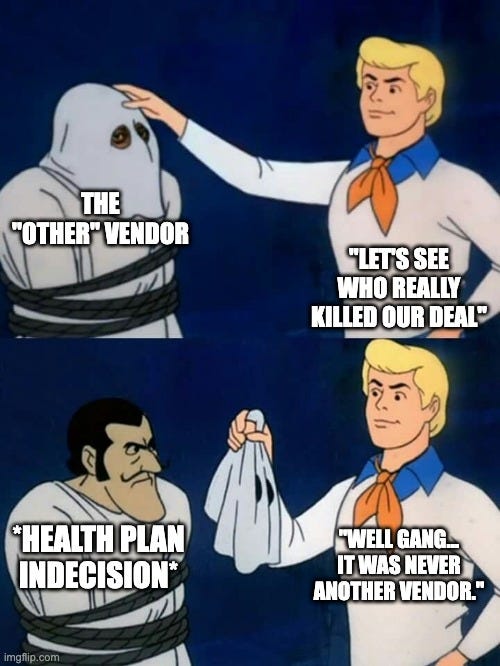
Three forces in particular are responsible for more lost deals than most sales teams realize. Health plans are choosing to do nothing instead of onboarding a new vendor. They're building capabilities in-house instead of buying them. And they're eliminating entire categories of vendor spend from their budgets because they've decided the categories themselves aren't worth funding this year. Most sales teams never categorize a loss this way, so they keep losing the same way without realizing it.
When your team miscategorizes a loss as 'lost to competitor' or 'deal slipped,' they apply the wrong lessons. They refine positioning against a vendor that wasn't the threat. They assume 'better timing next quarter' when the structural problem will be exactly the same next quarter. Over time, the team gets better at solving problems…but, that may not be the real ones.
Below, I’ll break down what each of these invisible competitors looks like inside a health plan, how to spot when you’re losing to one of them instead of another vendor, and what to do about it, including when to recognize a deal is dead and walk away.
The Competitors That Never Show Up in a Pipeline Review
Health plans don’t run bake-offs the way tech companies do. More often, they compare you to their internal status quo more than to another vendor. Once you accept that premise, the framework shifts. The competitors that are actually killing your deals fall into three categories, none of which show up in a pipeline review.
Health plans don’t run bake-offs the way tech companies do. They compare you to their internal status quo more than to another vendor.
Doing Nothing
The status quo is the most powerful competitor in health tech. Change has real operational costs, and in a year when plans are focused on defending margins, keeping things the way they are will always be cheaper than onboarding a new vendor.
You know what this looks like. Your champion is enthusiastic, the evaluation went well, the clinical results were strong, and then... nothing. Just silence, because the plan didn’t choose a competitor. They simply chose not to choose.
Vendors miss this because "doing nothing" doesn't feel like a competitor; it feels more like a timing issue. Sales teams tell themselves the deal slipped to next quarter, but next quarter, the same dynamic holds because the operational burden of onboarding hasn’t changed, and the urgency hasn’t increased. At some point, the deal fades from the forecast, but nobody ever calls it a competitive loss.
Building In-House
Health plans are increasingly framing vendor functions as short-term fixes and internal capabilities as long-term strategy. HealthScape Advisors recently described the dual mandate facing plans as the need to stabilize performance in the short term while building capabilities for the future, and that framing is exactly why “we’ll build it ourselves” keeps showing up as the answer.
Plans don't need to be great at building software for this to work. The pitch to internal leadership ("we already have the data and the staff, let's invest in our own capability") is becoming easier to defend than "let's bring in a new vendor and hope this time is different." That doesn't mean plans are well-positioned to build. Most have spent the last decade outsourcing more, not less, and they're not staffed for product development. But the internal champion for "build" has a lower bar to clear than the one advocating for a new vendor, because redirecting existing headcount doesn't require a new budget allocation or a procurement cycle. And there's a psychological dimension that vendors underestimate: choosing another vendor feels like repeating the same decision, while choosing to build feels like charting a new direction. That sense of agency is hard to sell against.
This decision-making is showing up more often with solutions like analytics, care management workflows, risk adjustment documentation, and member outreach; anything that feels adjacent to capabilities the plan already has.
What’s changed, however, is the tooling. The explosion of AI-powered no-code and low-code platforms has lowered the technical barrier for plans to build functional solutions internally. Historically, most health plans (outside the largest nationals) didn’t employ engineers or product builders. They had IT departments that kept claims systems running and managed vendor integrations. Those are different skillsets and different mindsets than building new tools from scratch. But no-code and low-code AI tools are collapsing that gap. A plan that, five years ago, couldn’t have built a member outreach workflow without a vendor can now credibly attempt it with a small team and off-the-shelf AI tools.
The pressure on health plan CEOs only makes it worse. Health plan CEOs, at both public and private companies, are under increasing board-level pressure to demonstrate that they’re leading on AI, not just buying it from vendors. For a public plan, showcasing a proprietary AI capability during an earnings call or investor presentation signals a strategic vision. For a private plan, building internal IP and proprietary assets directly strengthens the organization’s valuation story. Every internal build that displaces a vendor function becomes an asset the plan owns rather than a subscription it pays for, and that distinction matters to investors and acquirers evaluating long-term enterprise value.
So you’re not just competing against the plan’s confidence in their own team. You’re competing against a CEO who wants to tell an AI leadership story, a board that wants to see proprietary assets on the balance sheet, and a new generation of tools that make “build” feel more achievable than it ever has. The internal advocate for “build with AI” has a structural advantage over your sales cycle: they don’t need to survive procurement.
Eliminating the Line Item
This is the one most vendors never see coming, because there’s no alternative to point to. The plan doesn’t choose another vendor or build in-house. They decide the entire category of spend is no longer justified. The budget is reallocated to something with a clearer regulatory mandate or a more direct impact on margins, and your category simply disappears from the priority list.
The margin pressure driving this is worse than most vendors realize. MA plans posted a collective underwriting loss of $5.7 billion in 2024. Total non-SNP MA and MAPD plan offerings nationally declined 10% from 2025 to 2026, with 2.6 million enrollees in plans that have been terminated entirely. When plans are exiting markets and cutting benefits at that rate, categories without a clear, immediate financial return get triaged out of the budget.
CFOs are often the ones making this call, evaluating whether an entire vendor category is defensible in a budget meeting, not just whether your specific contract pencils out. They’re not comparing you to another vendor, instead they’re comparing your category to every other line item competing for the same constrained dollars. And when the question shifts from “which vendor?” to “do we need a vendor at all?”, most sales teams aren’t equipped for that conversation.
The signal is subtle but recognizable. When a buyer starts asking, “What’s the cost of not doing this?” they’re often building the internal case to do exactly that: not do it. That question sounds like diligence, but it’s frequently an exit ramp. When you hear it, your deal has already shifted from a vendor evaluation to a category evaluation, and if you’re still pitching features and differentiation, you’re answering the wrong question.
Most vendors misread the signals for all three. They see a stalled deal and assume timing, see detailed technical questions and assume interest, or see budget scrutiny and assume they need a better ROI model. The playbook they’re running doesn’t account for an opponent that never shows up in the room.
Why Your Competitive Tracking Misses What's Happening Inside Health Plans
Every health tech sales org runs some version of competitive tracking. You monitor other vendors, prep objection-handling, and refine positioning against known players. It’s standard enterprise sales practice, and it works when you’re actually up against another vendor. The problem is that it doesn’t account for the deals you’re losing to something else entirely.
Health plan buyers don’t evaluate your solution the way you evaluate your competitors. You’re comparing features and pricing against other vendors. They’re comparing your entire category against alternatives that don’t involve a vendor at all, and in many cases, the fight you’re preparing for isn’t the one you’re actually in.
The data makes this gap hard to ignore. According to a Black Book Research flash survey, 60% of CIOs have active pause directives on new platform purchases, extended payment terms on new contracts, and a hard pivot toward projects demonstrating ROI within 12 months. When budgets tighten to that degree, the competitor isn’t another vendor offering a cheaper version of what you do. It’s the decision to spend nothing at all. And that decision doesn’t require a committee meeting, a procurement process, or a vendor evaluation. It requires only inertia, which is the one thing health plans have in abundance right now.
How plans respond to this pressure varies dramatically based on their financial position and strategic posture. A frozen health plan that doesn't buy anything until the market stabilizes presents a completely different competitive dynamic than one that selectively funds initiatives with near-term payback, or one that buys only what a compliance mandate requires.
When teams don’t adjust for these differences, they keep refining their pitch against the wrong opponent. They win the vendor comparison and still lose the deal because the plan decided the category itself wasn’t worth funding this year. Your team walks away thinking you lost to a competitor or that the timing wasn’t right, when you actually lost to something you never identified as a threat. The same pattern repeats next quarter, and your win rate declines for reasons your competitive intelligence can’t explain.
This is why so many health tech vendors are seeing pipeline metrics that don’t make sense. Win rates against named competitors hold steady, but overall close rates are dropping. Deals take longer without clear competitive pressure, and forecasted revenue continues to slip. Those are the symptoms of losing to invisible competitors, and the standard tracking framework can’t diagnose them. Which is why it’s worth paying attention to what health plan buyers are actually telling you when deals stall.
What Health Plan Buyers Are Really Signaling (And What They're Not)
When a buyer mentions a named competitor, “We’re also looking at [X],” it often has nothing to do with your competitive positioning. They may be testing your confidence, creating negotiating leverage for a deal they’ve already decided to do with you, or giving you a convenient explanation for a decision that was actually made for internal reasons they don’t want to discuss. Sure, sometimes they’re genuinely evaluating alternatives, but often enough, you should pay attention to what isn’t being said.
The stall with no objection. When your deal has moved through a thorough evaluation with strong engagement at every stage, and then stalls with no clear objection surfaced, you’re probably losing to “doing nothing.” The plan hasn’t rejected your solution. They just can’t generate enough internal urgency to justify the disruption of onboarding a new vendor. Your champion may still believe in you, but they can’t sway their organization.
The questions that go too deep. When the buyer starts asking detailed technical questions about your architecture, data model, and integration requirements beyond what’s needed for a standard evaluation, pay attention. They may be scoping an internal build. Those questions aren’t about understanding your solution. They’re about understanding whether their team could replicate it.
The shift to "help me justify this." When the buyer’s tone shifts from “how does this work?” to “help me make the case to my CFO,” the line item itself is at risk. They’re not asking for your help selling the solution internally. They’re signaling that the category of spend is under threat and they’re looking for ammunition to defend it, which means someone above them is already asking whether this money should be spent at all.
Your reputation matters here more than most vendors realize. Plans evaluate vendors through peer networks and industry relationships before you ever get into the room, and a strong reputation can inoculate you against some of these invisible competitors. The plan that trusts you is less likely to default to inaction.
And if you’re a health plan leader reading this, here’s where this framework applies to you, too! Honestly, telling a vendor “we decided to build this internally” or “this category got cut from the budget” is more useful than “we went a different direction.” It saves time for both sides and preserves the relationship for future budget cycles.
You've reached the end of the free article. Everything above is the framework. Below is how to actually fight back: specific repositioning moves for each invisible competitor, when to walk away, and how to restructure the competitive conversation with your team.
Paid subscribers get this section plus the full archive of frameworks, scripts, and deep-dives.
🔒 Upgrade to a paid subscription to keep reading.