
Health Plan Buyers Have Split Into Three Camps. Here's How to Sell to Each One.
The same pitch won't work on a plan cutting vendors and a plan accelerating investment. This is the qualification framework and playbook for selling to each one.

Upward Growth provides health tech leaders with the playbooks and proof to transform complex markets into real growth. Each week, we deliver clear, practical strategies on positioning, messaging, and growth, so leaders can close enterprise deals and build repeatable momentum.
🤝 Work with Ryan on payor growth strategy: Contact me
🟦 Connect with the author, Ryan Peterson, on LinkedIn.
💡 Newsletter sponsorships are available: Learn More
(This is the third in a series of deep dives on five health tech trends shaping sales cycles in 2026. The first two covered why health plan buyers are scrutinizing vendor financial health and the prior auth compliance window. Trends 4 and 5 will be published in the coming weeks.)
Health plan buyers are responding to the same policy pressures in fundamentally different ways, and six weeks into 2026, those differences are showing up in every pipeline. Some buyers have frozen vendor spend entirely. Others are accelerating purchases faster than they were twelve months ago. And a third group is buying regardless of financial conditions because a regulatory deadline leaves them no choice. Same market, completely different purchasing behavior. The reason has nothing to do with your product or your team's effort. It has everything to do with how each plan is positioned financially and strategically heading into the rest of the year.
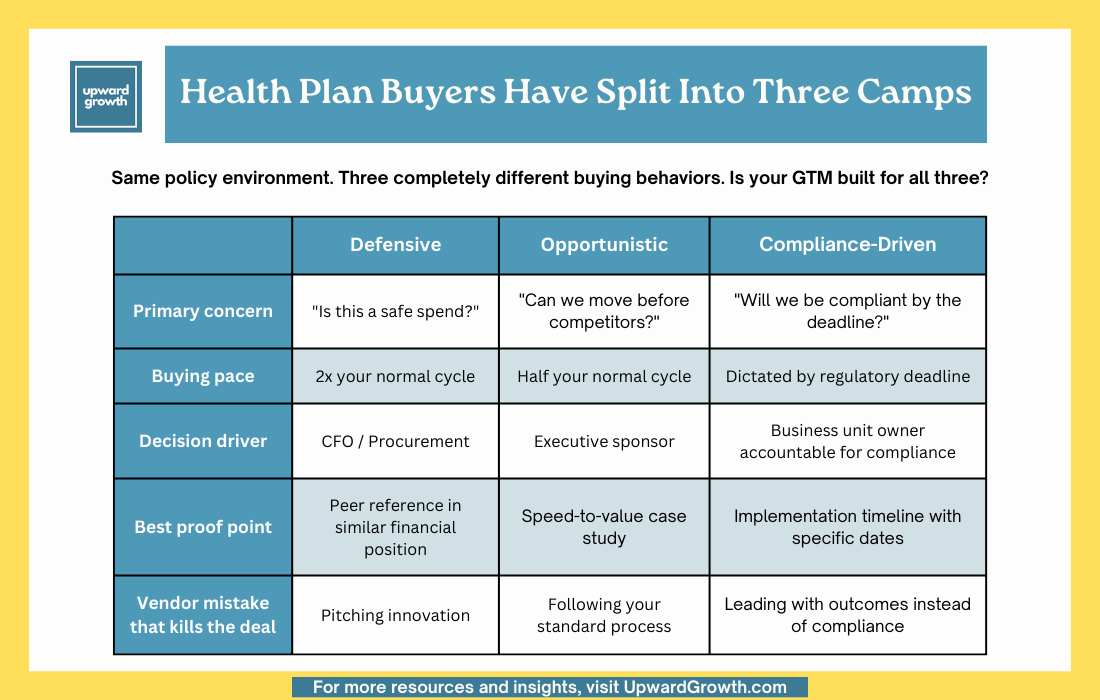
That positioning is playing out in three distinct ways. Defensive buyers are freezing spending and scrutinizing every vendor. Opportunistic buyers are accelerating investment while competitors pull back. Compliance-driven buyers are purchasing because a CMS deadline forces their hand, regardless of market conditions. If you’re running one sales motion across all three, you’re misreading at least half of your pipeline.
Most vendors are treating the current environment as universally “harder” and responding with a single strategy, usually something like “be patient and offer more proof.” That misses what’s actually happening. Closing a defensive buyer requires a fundamentally different deal architecture than closing an opportunistic one, and selling outcomes to a plan that’s buying compliance is answering a question nobody asked.
Below, I’ll break down what’s driving the split, how to recognize which of the three camps a health plan falls into, and the specific qualification questions, messaging shifts, and deal sequencing that match each one.
Why the Split Is Happening Now
The three camps map directly to the line of business (LOB) to which a plan is most exposed, and four LOBs are producing distinctly different purchasing responses right now. Knowing which pressure is driving your buyer also tells you something the framework alone can't: which buyers are likely to shift camps over the next 12 months and which ones are locked in.
Let’s quickly review each LOB and the buyer behavior it's producing:
Medicare Advantage plans collectively posted a $5.7 billion underwriting loss in 2024. Total non-SNP MA and MAPD plan offerings nationally declined 10% from 2025 to 2026. National plans such as UnitedHealthcare, Humana, CVS Aetna, and Elevance each scaled back operations in at least 100 counties, while six MAOs ceased operations entirely. For the first time in nearly two decades, as health plans prioritize margins over membership, that same contraction is creating opportunities for regional and health-system-owned plans to pick up displaced members in markets the nationals have abandoned. One carrier’s defensive retreat is another carrier’s growth thesis.
Medicaid is facing a structural funding shift. The reconciliation law cut roughly $900 billion to $1 trillion in federal Medicaid funding over ten years. States are already cutting provider reimbursement rates, suspending rate increases, and eliminating optional benefits. CBO estimates that 7.5 million additional people will be uninsured by 2034 from the Medicaid changes alone. MCOs are in defensive mode on discretionary vendor spend, but compliance requirements are simultaneously creating mandatory technology spend. More frequent eligibility redeterminations, the launch of work requirement systems in 2027, and new enrollment verification processes all require technology that MCOs can’t defer, regardless of their financial position. Medicaid is producing defensive and compliance-driven buyers at the same time, often within the same organization.
ACA enhanced premium tax credits expired at the end of 2025. The House passed a three-year extension in January, but the Senate has not acted, and the path forward remains unclear. ACA marketplace premiums are rising an estimated 26% on average, and plans are split between pulling back from marketplace exposure and doubling down in geographies where competitors are retreating. It mirrors the MA dynamic on a smaller scale: the same uncertainty is creating both defensive and opportunistic responses depending on the plan's financial position and risk appetite.
Commercial group health plan costs are projected to rise nearly 9% in 2026 before employer cost-cutting measures, the steepest increase since 2010, with 59% of employers planning cost-cutting changes to their health plans. Employers are pushing plans harder than they have in years, and plans that demonstrate cost-containment results are winning renewals. This pressure is making commercial plan leaders more willing to invest in vendor solutions that reduce medical or administrative costs, and more willing to move quickly on those investments. Commercial is where most of the opportunistic buying behavior is concentrated right now.
What matters for vendors is not the policy detail itself but the purchasing behavior it produces. And right now, those behaviors are clustering into three recognizable patterns.
Defensive, Opportunistic, and Compliance-Driven: What Each Buyer Looks Like in Practice
The previous section explains why the split is happening. This section is about pattern recognition: how to identify which camp you’re sitting across from before you’ve invested months in the wrong approach.
Defensive Buyers
These are plans with thin or negative margins, direct exposure to the policy shifts above, and leadership teams in preservation mode. Plans that exited markets, cut benefits, or are actively restructuring vendor relationships. The CFO has become the gatekeeper for every dollar of new spend.
You’ll know you’re dealing with a defensive buyer by what happens in the first two meetings. Evaluation timelines stretch without explanation. Pilot-first requirements show up with exit clauses attached. Questions about contract flexibility and termination terms surface before you’ve presented outcomes. Budget conversations reference “this year’s remaining allocation” rather than “next year’s plan.” Procurement asks about your financial stability before evaluating your product. And stakeholders you’ve never met start entering the evaluation late, which is a sign that more people now need to sign off on smaller dollar amounts. If you’ve read the Trend 1 deep-dive on vendor stability scrutiny, defensive buyers are the ones driving that dynamic.
What's happening inside the plan: a bad quarter prompted the CFO's office to lower discretionary spending thresholds, which means deals that used to require three signatures now require six. Your champion still wants to buy, but they're running an internal approval gauntlet that didn't exist eight months ago, and every new signature is another opportunity for someone to kill the deal. That's why the timeline keeps slipping without anyone telling you why.
Everything about their behavior points toward a single priority: the safest, most defensible spend. “Defensible to the board” matters more than “best ROI.” They want to be able to explain the decision if it goes wrong, not just if it goes right.
Vendors almost always get this wrong by leading with innovation or differentiation. Defensive buyers don't want to hear how you're different. They want to hear how you're safe, proven, and reversible. Every slide about your proprietary technology or unique methodology increases their perceived risk.
Opportunistic Buyers
These are plans with strong balance sheets and leadership teams that see the current environment as an opportunity to gain ground. You'll find them among regional plans or health-system-owned plans picking up members in markets the nationals abandoned, and among commercial plans under employer pressure to find cost containment wins and willing to invest to get them.
You'll recognize these buyers quickly because everything moves faster than you expect. They ask you to start sooner than your standard implementation allows. Questions focus on scalability and multi-market deployment rather than contract protections. Oftentimes, senior VPs or C-level folks attend earlier-stage meetings instead of waiting for the final decision-making presentation. Yes, they may be running competitive evaluations, but the pace is fast, and the questions are forward-looking. Another tell is they are less guarded about their strategy, because they see the current environment as an advantage they're actively trying to press.
So what’s happening inside opportunistic health plans? Leadership has already made the strategic decision to invest, and the budget is allocated or being allocated. Your contact isn’t trying to build a business case from scratch, they’re trying to execute on a directive that came from above. That’s why the executive shows up early. They’re not evaluating whether to spend, they’re evaluating whether you can move at their speed.
These buyers are optimizing for speed to competitive advantage. They want to move while others are frozen, and they're willing to accept imperfection if the upside is clear and the proof is real. The mistake vendors make is moving too slowly. If you run your standard six-month enterprise sales cycle with an opportunistic buyer, they'll find someone who can start in 90 days.
Compliance-Driven Buyers
These are plans that must purchase regardless of financial conditions because a regulatory requirement demands it: prior auth automation under the CMS interoperability rule, quality measure reporting systems, eligibility redetermination technology for Medicaid as states implement more frequent redetermination cycles, and prepare for work requirement verification in 2026-2027.
You'll recognize compliance-driven buyers by what's missing from the conversation as much as what's in it. There's almost no discussion of ROI or strategic outcomes in early meetings. Instead, RFPs include specific regulatory language traceable to a CMS final rule, timeline conversations anchor to compliance deadlines rather than budget cycles, and IT and compliance teams lead the evaluation rather than clinical or operational buyers. When you ask, "What's driving the timeline?" the answer often refers to a specific regulation or date rather than a strategic initiative.
The counterintuitive part: risk tolerance among compliance-driven buyers is actually high for the right solution, because the risk of non-compliance is higher than the risk of picking the wrong vendor. “Will this keep us compliant by [date]?” is the only question that matters in the first three meetings. (ROI is real but secondary).
But don't mistake regulatory urgency for an easy deal. Compliance purchases have their own brutal internal politics. Sure, the mandate comes from CMS, but the organizational readiness to execute it is a separate question. Vendors who read compliance urgency as a frictionless sale get blindsided when the organization can't keep up operationally.
This framework so far assumes each plan fits neatly into one camp. Most don’t, and the next section explains why that matters more than the framework itself.
Most Health Plans Don’t Fit Neatly Into One Camp
If the framework above seems clean, that’s because real organizations are messier than frameworks. Large health plans, especially multi-LOB nationals, can sit in multiple camps simultaneously.
A large national plan might be defensive in Medicaid (cutting MCO vendor spend as states slash reimbursement), opportunistic in commercial (investing in cost containment as employer demand surges), and compliance-driven in MA (racing to meet prior auth automation deadlines). Same plan, three different purchasing postures running in parallel.
You’re not selling to ‘Aetna.’ You’re selling to a specific budget, owned by a specific leader, inside a specific line of business, under specific financial pressure.
This is why enterprise qualification must occur at the initiative level, not the plan level. You’re not selling to “Aetna.” You’re selling to a specific budget, owned by a specific leader, inside a specific line of business, under specific financial pressure. The vendor who walks into a national plan meeting with a single pitch is going to get it wrong in at least two of the three rooms. Your discovery questions need to identify which camp this initiative belongs to, not which camp the plan broadly occupies. Financial pressure in one line of business ripples across the organization, but purchasing behavior varies by budget owner, leader, and LOB.
It also means camps can shift mid-deal. A plan that started as opportunistic in Q1 can flip to defensive by Q3 if a bad earnings quarter triggers a spending freeze. If your champion suddenly starts asking about pilot options and exit clauses when they were talking full deployment two months ago, the initiative moved camps. The worst thing you can do at that point is to keep running the opportunistic playbook after the buying posture has shifted beneath you. Recognize the shift, adjust your approach, and re-qualify.
Five Questions That Tell You Which Camp You’re Selling Into
In the original five-trends article, I offered a single qualification question: "How is your organization responding to the current policy environment?" It's a good opener, but it's not enough to classify a buyer on its own. The five questions below work as a conversation flow, not a checklist. And to be clear, you're listening for patterns across the answers, not scoring each one independently.
1. “How is your organization responding to the current policy environment, accelerating investment or pulling back?” This question rarely produces a straight answer. Most buyers give a general, slightly optimistic response regardless of their actual position. But that’s useful in itself. It tells you how the buyer sees themselves, and the gap between their self-perception here and the reality that surfaces in questions 2 through 5 is often the most revealing signal of all.
2. “What’s driving the timeline on this initiative?” This is where the real classification lives. A regulatory deadline points to compliance-driven. A strategic goal or competitive positioning points to opportunistic. “We need to show savings this year” or “we’re rationalizing our vendor portfolio” points to defensive. The language they use matters as much as the answer.
3. “Who needs to approve this beyond your team?” The approval chain tells you more about the buyer’s camp than almost anything they’ll say directly. Heavy financial oversight (CFO, VP of Finance, budget committee) signals defensive. An executive sponsor already aligned and pushing the process forward signals opportunistic. Compliance and business unit owners leading the approval chain often signal compliance-driven.
4. “What happens if you don’t move forward this year?” Listen for the consequence, not just the answer. Defensive buyers describe the status quo: “We keep doing what we’re doing.” Opportunistic buyers describe a missed window: “we lose ground” or “competitors get there first.” Compliance-driven buyers describe a penalty: “we’re out of compliance” or they reference a specific audit risk.
5. “Is this budgeted, or does it need to be budgeted?” Already allocated budget usually means compliance or opportunistic, the money is committed because the initiative has urgency or mandate behind it. If it needs new budget approval, you’re likely working with a defensive buyer, and you should plan for a longer, harder close.
The pattern across these five answers tells you which camp you’re in.
You’ve reached the end of the free article. Everything above is the framework: what’s driving the split, how to recognize each camp, and the five questions that classify a buyer. Below is the execution layer: camp-specific messaging, proof points, deal sequencing, and the mistakes that kill deals when you run the wrong playbook.
Paid subscribers get this section plus the full archive of frameworks, scripts, and deep-dives.
🔒 Upgrade to a paid subscription to keep reading.